When to let my son go on social media
 Carlos Sahuquillo
·
3 julio, 2017
·
10 min de lectura
Carlos Sahuquillo
·
3 julio, 2017
·
10 min de lectura

It’s a recurring theme like the passwords (we’ll talk about those, already): minors and social networks… can I let my son be released on social networks? On many occasions, both friends and parents of my children’s school ask me what precautions to take and what safety measures to apply so that their children will be discharged on one of the social networks, being the ‘trending’ network these days https: / / www.instagram.com /.
Needless to say, before we get discharged on the social network on shift, We should read the privacy policy to know what they’re going to do with our data. with the photos we upload, if we are going to receive advertising, etc. Yeah, privacy policy is that page we didn’t even read when we discharged a few years ago, the bad thing is that some networks know we’re not going to read this page. We’re gonna sign up for the first fail. Related to this, I’m going to tell you a snapshot: a few years ago, a girl posted a picture of a butterfly on her account of flickr. A
a T-shirt company liked this photo, made T-shirts with the butterfly photo and the T-shirts were sold reasonably well. When the girl found out, she called the T-shirt company very angry and she explained that they had LEGALLY bought the photo from Mr. Flickr, as when she uploaded the photo to flickr, she did not change the default license options and the owner of the photo, so the owner of the photo became flickr… and our friend did not see a hard The euro of the T-shirts and the sale of your photo. So Let’s read the privacy conditions before we discharge., val
E?
Minimum age
Most social networks ask us for some personal data to release us such as names, surnames, age, etc. As those data are personal data are protected by Spanish law in our case (as Spanish citizens), in particular in Article 13 of the Royal Decree 1720 / 2007of 21 December adopting the Regulation on the development of Organic Law 15 / 1999 of 13 December on the protection of personal data. This article states that in order to give up our
personal cough, we have to have over 14 years or otherwise we will need a parental consent (or maternal consent, which today we have to walk with feet of lead). The Royal Decree itself explains in article 15 what this parental / maternal consent should be like… and no, it’s not worth telling you ‘Yeah, honey, of course you can discharge, but be careful who you’re talking to around.‘
This happens with the current legislation… but In a few months we will have the new European Data Protection Regulation which shall be binding on 25 May 2018… and that It’ll make us wait until we’re 16. so we can give up our data. That is, we will need to be the same age as is currently necessary to be able to enter the labour market or to drive a bike up to 125 cc (A1).
However, if we enter the Terms of use of InstagramWe will see that they indicate that the minimum age is 13… and yes, it is in some countries, but our legislation forces us to wait at 14, so we have to wait a year longer than our friend from New York that we met last summer in Jávea.
What about the other social media? They kind of follow the same line. For example, Facebook maintains the same policy as Instagram is part of Facebook. With WhatsApp The same thing happens to us… as it was bought on Facebook a few years ago, you have to be over 14 years old to be able to use it (https: / / www.Whatsapp.com / legal /? l = es # terms-of-service). In LinkedIn, the minimum age is 16 years (
l = es _ ES «target =» _ blank «> https: / / www.linkedin.com / legal / user-agreement? _ l = es _ ES, although since LinkedIn is a professional network, our son will surely not be too interested in sharing his resume by saying that it is yellow-orange belt in Judo or that he plays the flute like the very same angels.
Google for its part explains how this age can change in some countries and how some of its services require being older. Remember that a mobile with Android requires a Google account to work, although We need that our child has a mobile phone and is not old enough, we can always put our own account in order to use the phone:
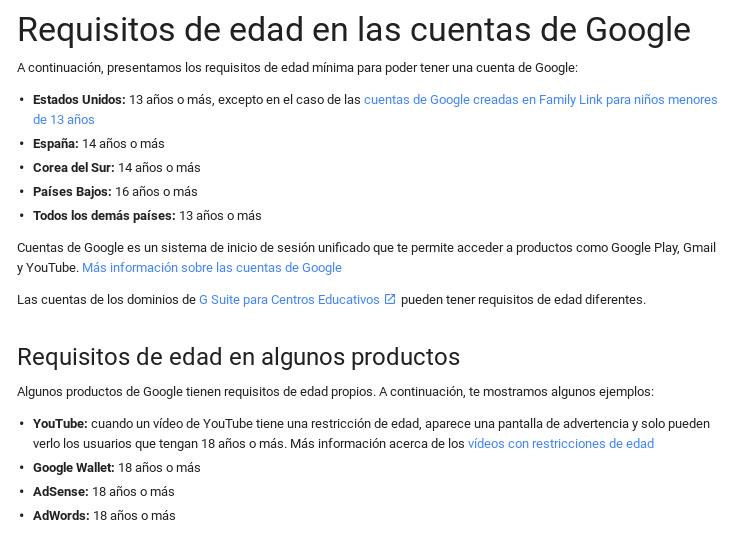
Once we get to this point, we have a moral dilemma. If our son is discharged by himself lying at his age, he is committing a crime of falsehood., which is very ugly… and If we let him go, we’re teaching him that sometimes you can lie and nothing happens.… which is also very ugly. And yes, I’m sure other children of your class have already mobile, WhatsApp or Instagram and are even discharged in Tinder (if you don’t know what Tinder is you can look at the website, just open the website doesn’t count as infidelity), but if I
We’re gonna let our son do it? So that’s it.
There is some exceptional case like the Twitter, since during the record you don’t ask how old you are. However, it has a guide for parents https: / / support.twitter.com / articles / 20169210 # with some recommendations to take into account before using its social network (public, by the way, everything we publish will be visible to all users… and what other users publish, too… whatever it is. Yeah, whatever. And that brings us to the next point.
What will the social network do with our data, our comments and our photographs?
And some of you will thinkReally? You say the social network is going to do something with my data beyond giving me access through an account?«Well, yes, they will normally be transferred to other group companies or other users for advertising and marketing purposes. In others, they will be allocated for purely statistical purposes to improve the service. In other cases, e-mail addresses will be sold to the best advertising bidder. But you can be sure that these data will be given as it is the way to maintain all the infrastructure a social network needs. You just have to keep that in mind, no.
It’s gonna happen to us like the butterfly girl.
What’s my son gonna see?
Another of the points you can read at the Terms of use of InstagramIt’s just… You shouldn’t. post violent, naked, partial, discriminatory, illegal, pornographic or sexually suggestive content (have not seen the accounts of the Women and Men and Vice-PresidentBecause of the fabric. Instagram of Samira Jalil, Instagram of Oria
na Marzoli, Instagram by Ana Isabel,…). This doesn’t mean you can’t do it, you just shouldn’t, so the content exists on the net. Do we want our son exposed to this kind of content? Surely not, but once you register on the network, nothing prevents you from looking for it in the application’s own search engine.
In Youtube For example, we can limit the type of content we want to see (https: / / www.youtube.com / account) but on other social networks such as those discussed above it is not possible to filter by type of content.
Educate before blocking
What is clear is that once our child is registered on the corresponding social network, it will be difficult to track him, so We can do two things… block content., inappropriate accounts and channels (which is quite difficult to maintain and if our child is really interested in looking for a way to skip it) or EDUCAR on the dangers or content you can find. A few months ago I gave a talk about this in a school and explained to the students that usually their parents will let them walk on the street alone, no need to go hand in hand… but what if they get to a c
Dark side? Well, they’ll feel like that street isn’t safe and they’ll go four steps back to find their parents and go through it together. With social media more or less the same, we have to explain that if they find something that makes them feel bad that they fear them, or that they just think it’s not right, must seek our help and advice. We have to explain. how long they should spend on the social network and what kind of information to share so as not to damage their reputation and to use the network properly. We must teach them to respect first and foremost and of course to avoid and know to detect the acus
so of any kind. We must repeat to them what we have told them as little children on the street: you should not talk to strangers. And above all we have to educate them about mistrust, warning and protection as basic principles.
Transparency… but the real one, not like the political parties.
One of the precautionary measures I have with my children is that they don’t know their passwords. With this we prevent them from putting in weak passwords that allow malotes to access their account after trying a couple of times (my older son always calls out the names of youtubs he likes or football players) and they are victims of some kind of deception to give up the password. In addition to this, we make sure that if at some point we have to review the content, conversations or photos uploaded to the social network, we can do so. Personally I’m not in favour of this kind of access, I think they’re violating your privacy and privacy. (and me r
When my mother looked at my jeans’ pockets with the excuse of putting them in the washing machine… when I was perfectly able to take them to the washing machine already checked!)… but it is likely that at least at first we would like to ensure that the social network is being used.
And protection ‘of father’
We must get our children to trust us, otherwise they will not want to tell us what is on social media. Just like they’d tell us a problem in the school yard or a partner who makes fun of them. No, it’s not easy, although we all certainly think that this point is more than just over, but we must reach a midpoint between privacy, privacy and trust.
Unfortunately, sometimes on social media people are not who they say they are.
Carlos Sahuquillo
'Haga lo que haga en la vida, siempre compito' - Jacques Villeneuve Reserva una sesión →
Entradas relacionadas

Home compatible podcast and YouTube channel!
You want to save yourself from reading the blog, but you're looking forward to starting taming your house? Now you can follow…
Leer
The minimum age for your child to use WhatsApp is now 16 years old
Idioma:CastellanoEnglish It’s a recurring theme like the passwords (we’ll talk about those, already): minors and social networks… can I let my son…
Leer
Security and Privacy in Big Data 2017
Idioma:CastellanoEnglish It’s a recurring theme like the passwords (we’ll talk about those, already): minors and social networks… can I let my son…
Leer
0 comentarios