The proactive medicine of the future: donor of data
 Carlos Sahuquillo
·
31 enero, 2018
·
7 min de lectura
Carlos Sahuquillo
·
31 enero, 2018
·
7 min de lectura
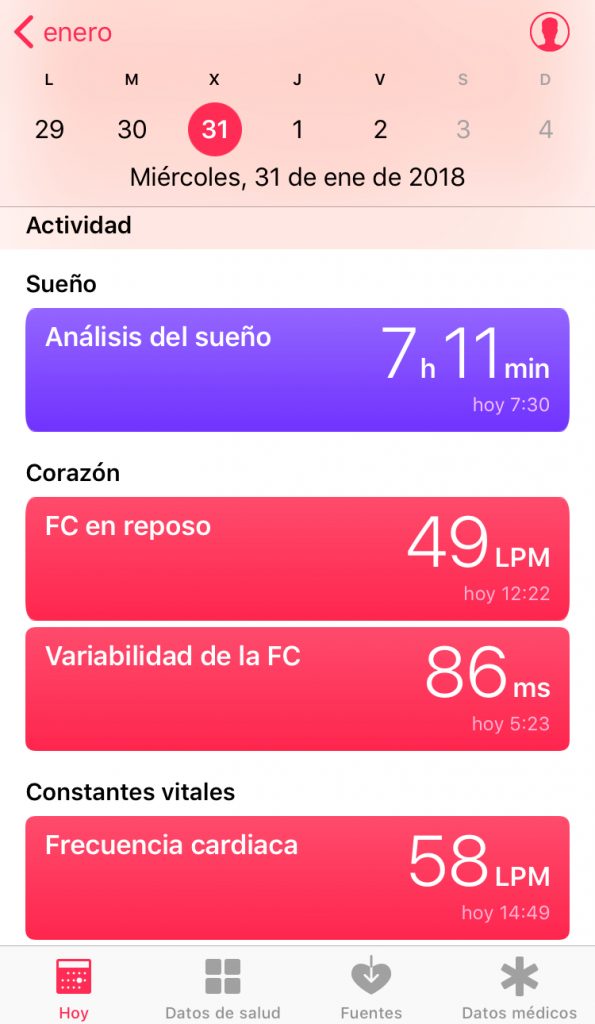
I’ve spent several years now talking about the proactive medicine we should be seeing with today’s technology. I think it was back when Apple introduced HealtKit in June 2014 alongside iOS 8 that I started noticing the advantages of sharing your Health data so that, at some point in the future, that data could actually be put to use. In truth, some data sharing was already happening before 2014, for example in sports apps that had been around for a while… I remember I started running back in 2012 using the Endomondo app on my phone to get metrics on pace, times, distance, and elevation gain… and as I’ve mentioned before, there’s nothing I love more than a good graph 😀
Thing is, with Endomondo I only got basic info about my workouts, without even monitoring my heart rate to gauge effort, so the graphs were a bit thin at the time: distance, time, route map, and elevation. That’s what you had to work with to get a rough idea of your effort and how you might improve your training.
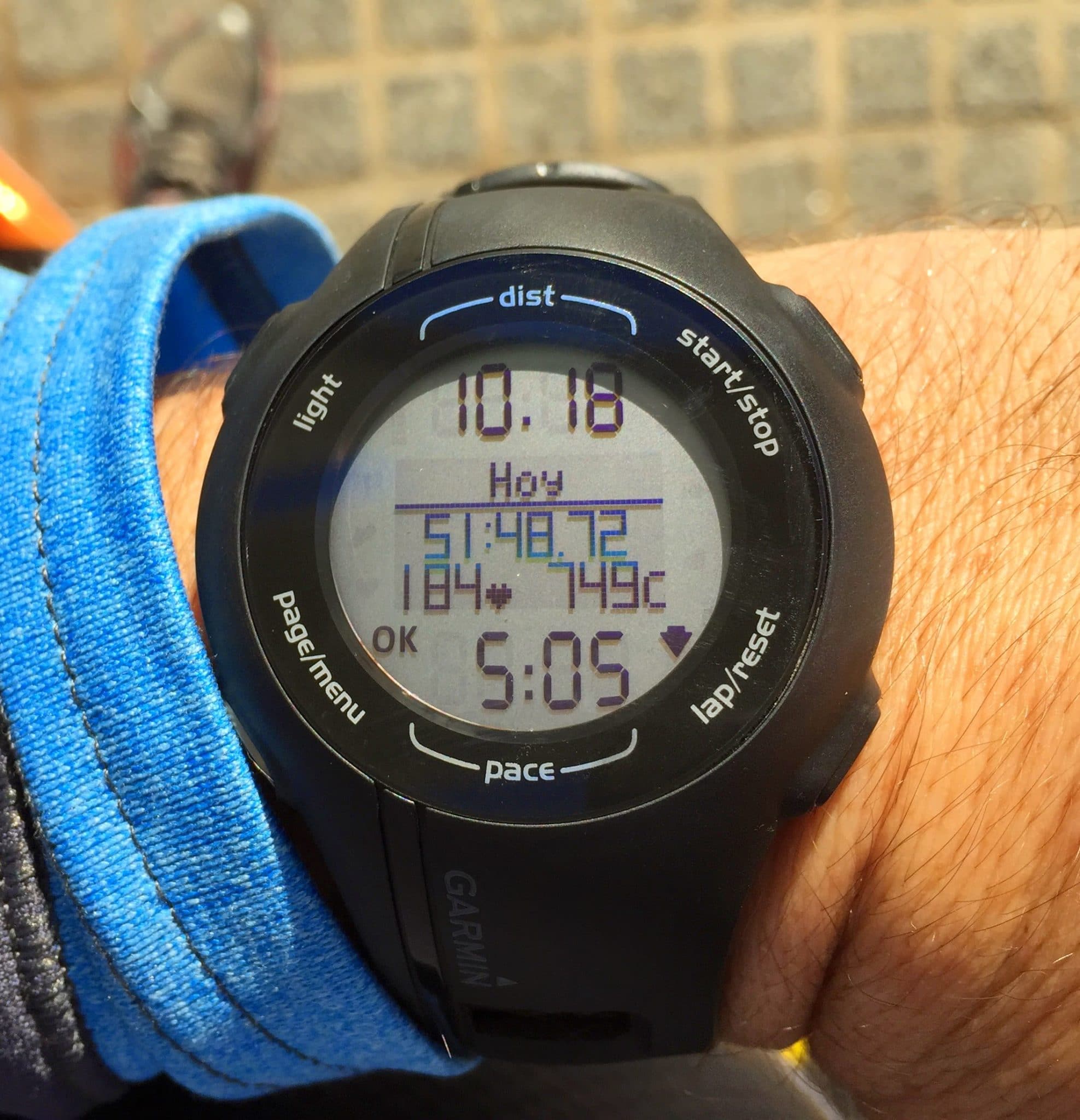
Shortly after, I created my own need to monitor my heart rate and bought a Garmin device to get that data. I won’t bore you with all the heart rate monitors that have passed through my hands, I’ve got a bit of a problem with this too (same as with graphs and the need to monitor everything), but I promise you, there have been a lot of them
Important data about your health
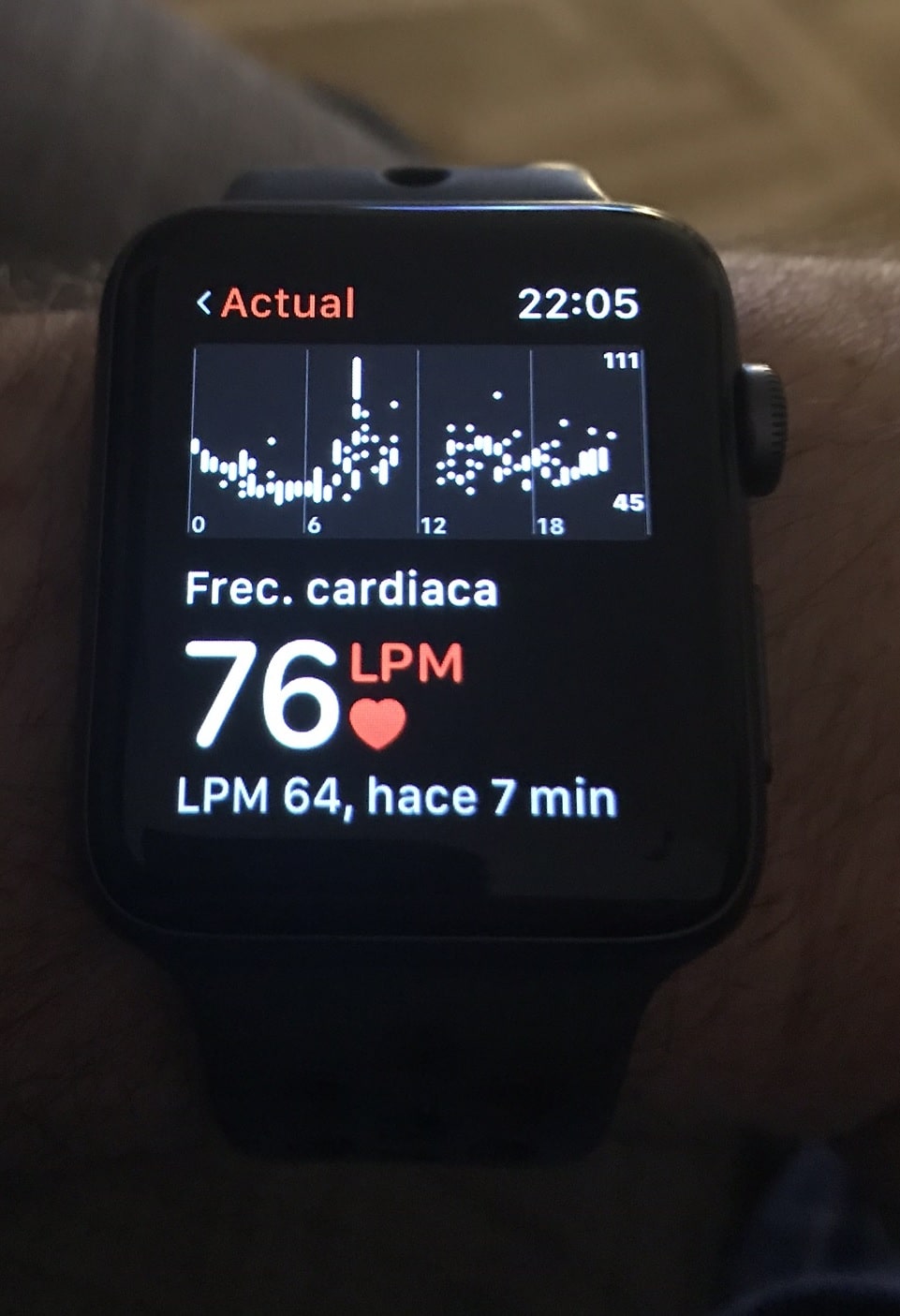
All this data gave me precise information about my fitness and performance, but obviously my doctor wasn’t going to log into Endomondo, my Strava profile, or my Garmin data page to check it out. Why do I have to go through a stress test if a cardiologist could just log into Strava and look at my heart rate while I’m training flat out? Doesn’t make much sense, right? That data was already out there, in the cloud, it just needed to be put to use… but nowadays we’ve taken it even further. I wear a fantastic Apple Watch on my wrist when I go running, and besides capturing all the workout metrics, it keeps track of my heart rate at regular intervals throughout the day, the exercise I get walking to work, or how many hours of sleep I’ve racked up over the past week. Wouldn’t it be great if my doctor could just call me up and say «Carlos, I’ve been looking at your heart rate and I’m seeing some odd spikes… come in and we’ll run a full check-up»? Obviously they’re not going to call and say «you’re about to have a heart attack in 3, 2, 1…» but it is possible to detect certain anomalies that would let us be proactive and avoid bigger problems down the road (no pun intended).
So why don’t they do it?
Basically, it’s not possible because of personal data protection laws. Currently, every study that uses this kind of data works from anonymized data, both to protect user privacy and to comply with international data protection regulations. In other words, the relevant public health body or institute can indeed get access to this data (as long as we’ve given our consent, more on that in a moment) but they can’t know who we are… doesn’t make much sense, does it? This runs counter to the whole idea of being proactive with end users, but anonymous data does let us do things like detect flu outbreaks early on, or spot rare diseases affecting a specific segment of the population. To do this, organizations and specialized companies don’t just look at the data from my Apple Watch, they also cross-reference it with pharmacy records to see what medications are being dispensed, hospital ER reports to see what symptoms patients are showing up with, and a bunch of other sources that give them a ton of information on which to run machine learning algorithms and Big Data techniques to detect patterns and trends (oh, you don’t know what Big Data is? Noted, we’ll cover that another day).
Personally, I think that’s great… but I want my doctor to actually warn me if something looks off! (my wife says I’m a bit of a hypochondriac and that this is the last thing I needed)
Massive, voluntary participation
A few years back, when a university or research institute wanted to run a study on some disease, they had to go out and recruit volunteers. Some volunteers would be given the drug or put through some kind of test, others a placebo, and then the data would be cross-referenced to produce results that pharmaceutical labs would apply to whatever medications they were developing. Nowadays, some of these studies can be automated through the phones we all carry, so the pool of volunteers multiplies and the results become far more reliable. For example, researchers at Stanford University developed the MyHeart Counts app, which collects heart rate data from everyone who has the app installed in an attempt to predict heart attacks and angina. Thing is, within 24 hours of its release, 11,000 people had installed it and given their consent for the data to be used in the study. Before platforms for sharing this kind of data existed, that same university would have needed a year and 50 medical centers to reach that same number… and with the app, they had it in 24 hours! The biggest challenge these studies face now is getting user consent, since international regulations don’t let you just say «sure, take all my data and do whatever you want with it», instead you have to give your consent individually for every single study that wants to use it… a real pain, honestly. It ought to be something more generic, like registering as an organ donor, but for becoming a ‘data donor‘. But given that under the current Organic Law on the Protection of Personal Data health data is classified as high-level and has to be guarded almost like it’s got rabid dogs defending it with their lives, I’m afraid we’re still a fair way off from that.
I want to be a data donor
I’m absolutely convinced that within a few years we’ll have some legal way to become ‘data donors‘, and that this data will be shared securely and privately, even if no longer anonymously. And it won’t be anonymous because of the benefit to the end user, who will finally see a clear return and a «reward» for sharing their health data, something that doesn’t currently exist and that’s holding back technology from being able to proactively improve our health the way it already could be.
Carlos Sahuquillo
'Haga lo que haga en la vida, siempre compito' - Jacques Villeneuve Reserva una sesión →
Entradas relacionadas

Automations and productivity with Power Automate
Since not everything in life is home automation, in this episode I tell you how I use Microsoft's Power Automate to automate…
Smart Bottle Low Cost
Drinking water is healthy and fashionable. Today I tell you how to have your own smart bottle for less than €4 and…
Leer
Now you can invite us to a coffee!
If you consider that the blog has brought you something positive (beyond economic spending), you now have the possibility to invite us…
Leer
0 comentarios