Attacks on self-driving cars
 Carlos Sahuquillo
·
22 junio, 2017
·
7 min de lectura
Carlos Sahuquillo
·
22 junio, 2017
·
7 min de lectura

Last week I was at the 2017 edition of the VLCSofting Congress organized by ITI in Valencia. This is the second time I’ve attended this congress as a speaker, and honestly I think it’s shaping up to become a great reference point in the city thanks to the technical level of the talks and speakers who show up for the event. This year, for example, there was a talk by Google and another by Microsoft, among others equally interesting… except mine, of course. Next year’s talk in 2018 will be titled ‘Car Hacking’ and we’ll dig a bit deeper into the subject.
This time, my talk was called «Trolls and Self-Driving Cars«. That’s not the original title, since I wanted to call it ‘Bullying Self-Driving Cars‘, but in the end my wife (a saint, I tell you) made me see that title was a bit too aggressive and could come across as offensive 😀 The main idea of the talk was to lay out the current ‘state of the art’ of self-driving cars today, since even though we don’t see them yet in Spain, in other cities around the world there are already autonomous vehicles out practicing and learning from their surroundings. In cities like San Francisco, for instance, it’s starting to become common to see a car where the driver doesn’t have their hands on the wheel (though you still won’t see fully autonomous cars with nobody behind the wheel at all):
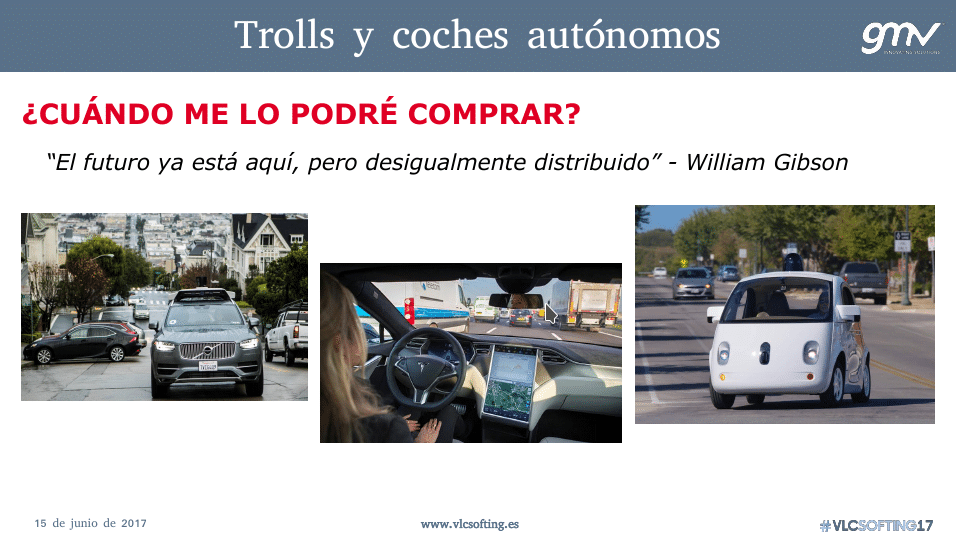
What features should a self-driving car have?
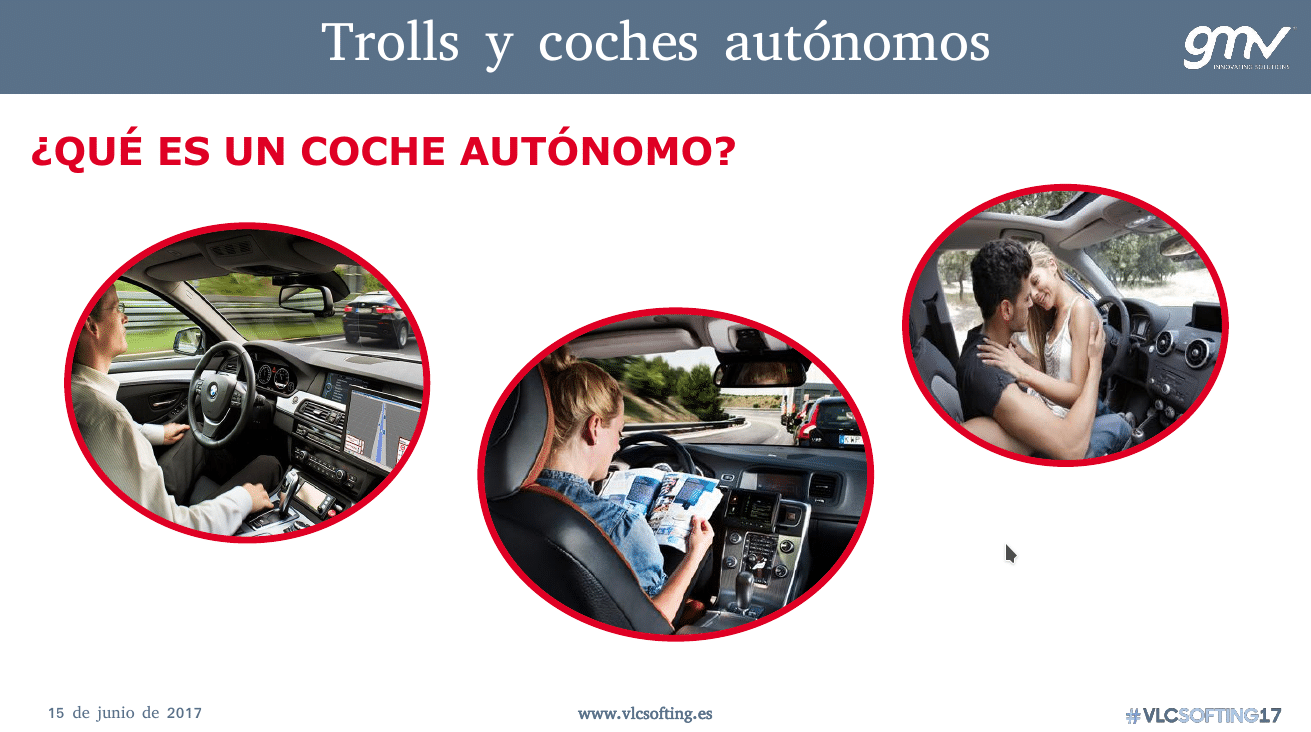
First off, we talked about what a self-driving car actually is. And no, it’s not any of this:
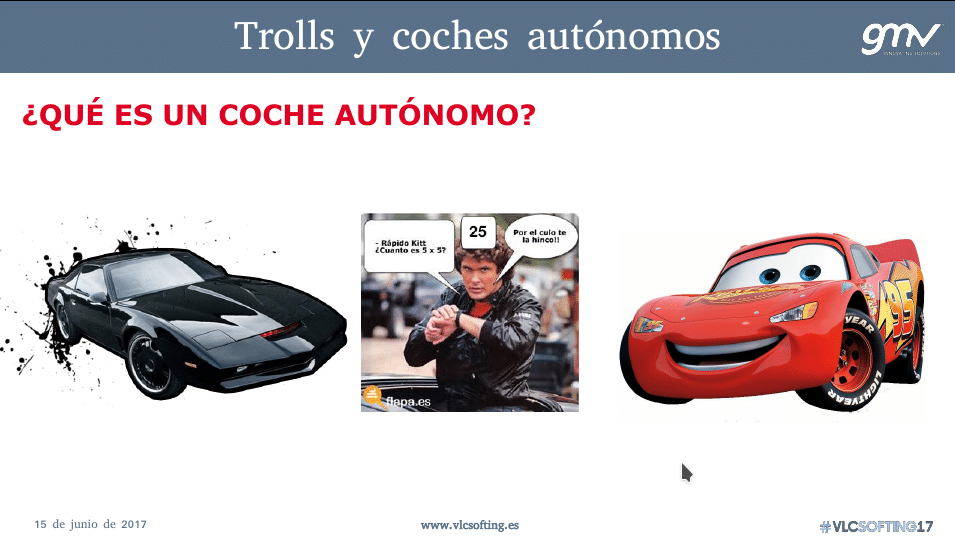
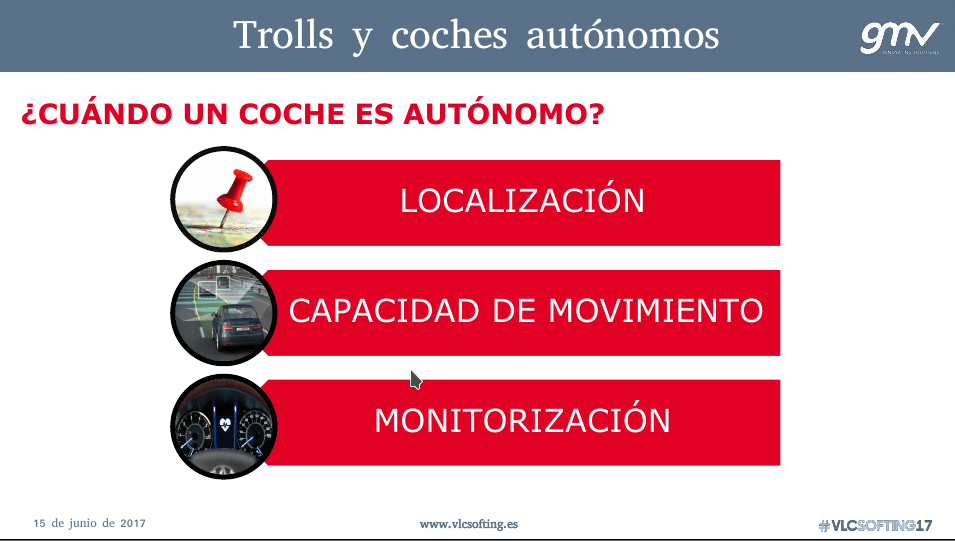
The three conditions a car must meet for us to call it self-driving are these:
And obviously, there are different levels of autonomy. Several frameworks try to lay out these levels, but the most widely used one nowadays seems to be the one created by the National Highway Traffic Safety Administration, which defines these levels:
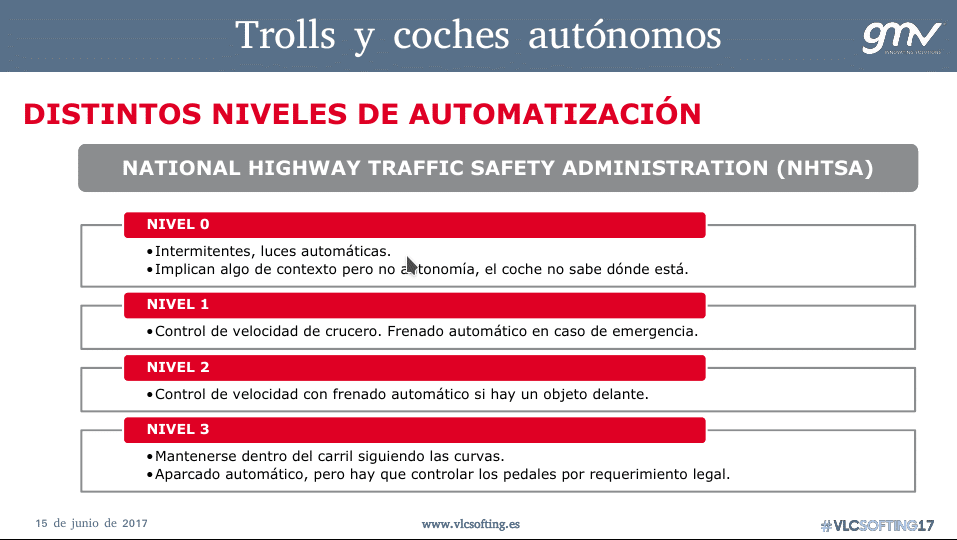

As unbelievable as it may seem from where we stand, some manufacturers already have level 4 self-driving cars just around the corner, for example these three:
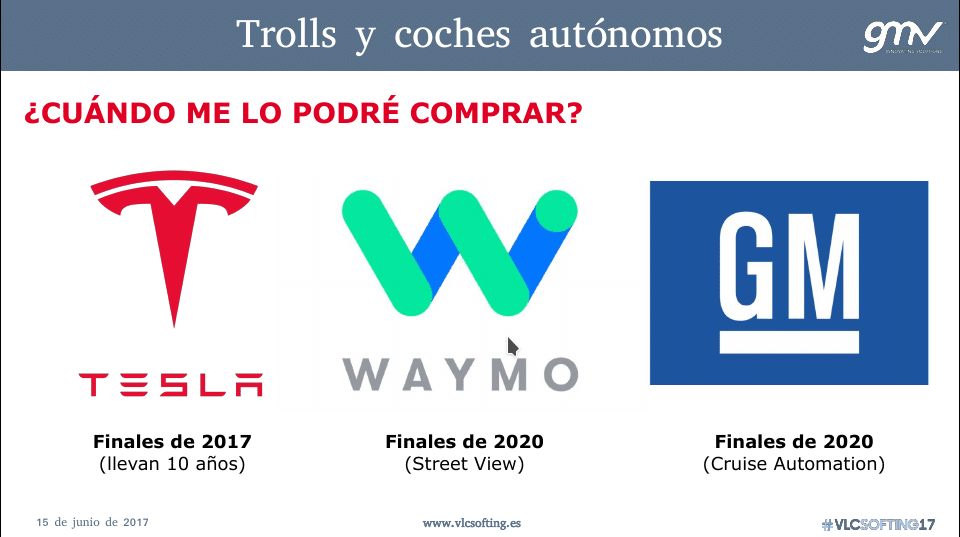
This means that by the end of the year we might already see level 4 Teslas driving around the streets! With no driver!! In Spain we’re still a bit far from this since the law doesn’t allow it yet, but little by little we’ll see the legislation change and these cars start showing up on our streets. In fact, even though we might start seeing level 4 vehicles by the end of the year, Tesla folks say they’ll show one of their Teslas driving from San Francisco to New York with level 5 autonomy, which means it will need to be able to refuel (or recharge its batteries) autonomously along the way (https://www.theverge.com/2016/10/19/13341100/tesla-self-driving-autonomous-road-trip-la-nyc). And you might be wondering, why can Tesla pull this off while other manufacturers can’t? Obviously it comes down to the type of ‘gas stations’ each one uses—Tesla has spent years setting up its Superchargers and rolling them out across different cities so that this moment would eventually be possible.
Risks of the technology
After this little introduction to set the scene, we talked about the risks that come with new technology (I don’t know if you’re aware, but every time someone says ‘new technologies’ to refer to technologies that have been around for over 20 years, God kills a kitten). Currently, car manufacturers take about 5 years to develop and test a new technology before it reaches the street and is accessible to everyone. However, with the new processors that vehicles need to include and their associated software, this timeline just doesn’t hold up anymore. Both the hardware components and the cybersecurity mechanisms we had 5 years ago have changed COMPLETELY, and what was secure 5 years ago is now a potential attack vector because vulnerabilities keep being discovered. We also need to factor in the inherent risks—we’re not going to get into the moral and ethical questions of whether your car would throw you off a cliff rather than crash into a school bus—but rather the current technological problems related to intra-vehicle networks (V2V and V2I), the new IEEE 802.11-p WiFi standard, or computer vision issues that prevent current cameras from telling whether the image they’re seeing is another car or our own car reflected in a mirror:

What’s clear is that self-driving vehicles are going to arrive in the coming years and completely change the way we think about cities and roads. For example, it will no longer be necessary to widen roads, since our autonomous vehicles will be able to drive more efficiently:
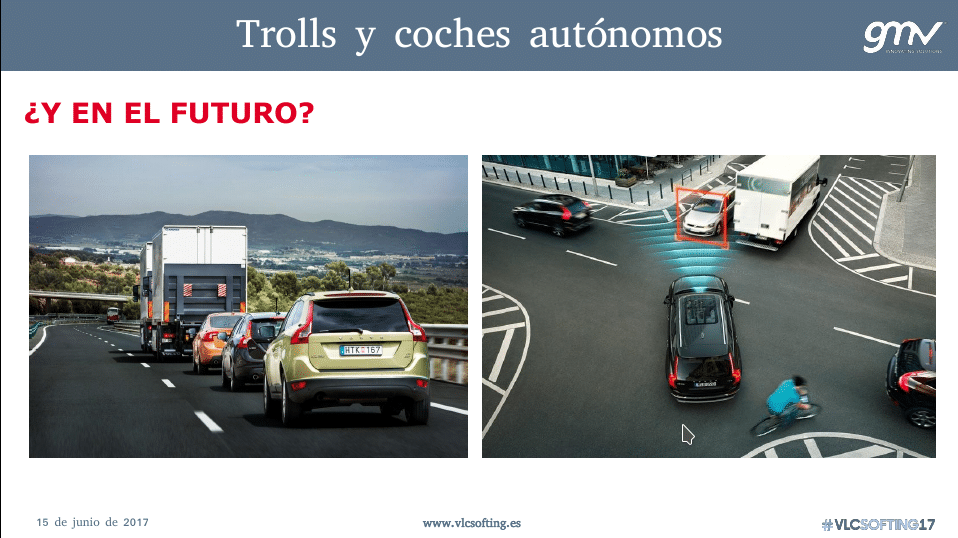
This image would be reckless on a public road where we need to keep a safe distance in case we have to react, but with self-driving cars there will no longer be a need to maintain that distance… not just because the car can react much faster if the one ahead stops, but also because, being connected to the other cars, it will already know that 7 cars up the road have started braking.
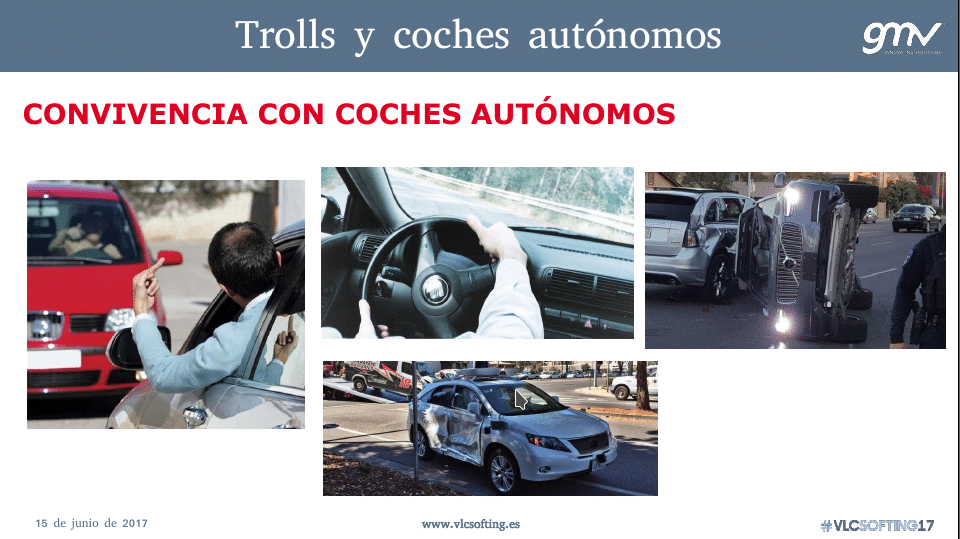
Needless to say, speed cameras won’t be necessary anymore (woohoo!). In exchange, we’ll have to endure the ‘adjustment’ period, living alongside driver 1.0s and self-driving cars for a few years, which won’t be easy at all and will let us do things like messing with a self-driving car to make it stop or pull over:
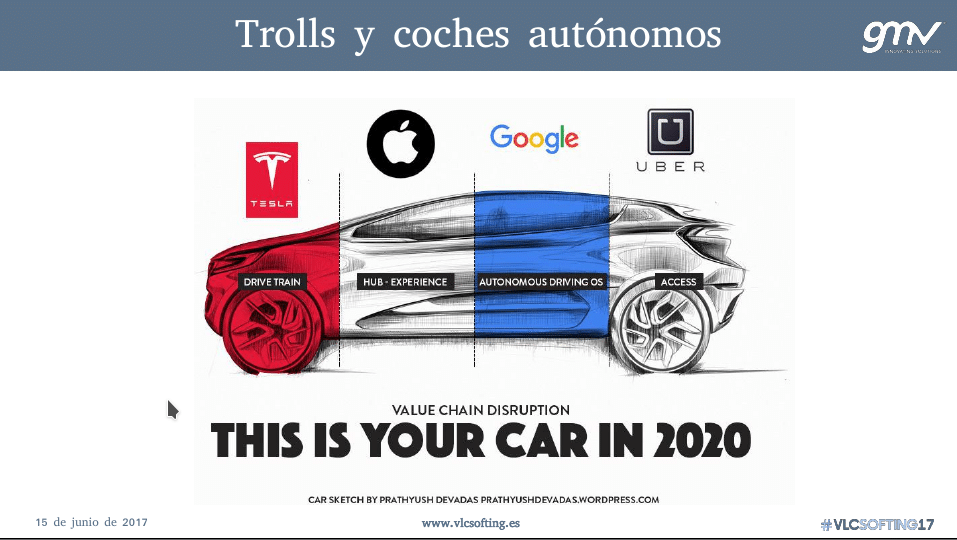
Finally, what seems achievable a few years down the line is reaching a pay-per-use model with several players working together: a company like Tesla handling the engine and battery side, someone like Apple handling comfort and user interaction, Google providing ‘the brain‘ to correlate all the data from the vehicle’s autonomous side (remember that a self-driving vehicle can generate around 600 Gbps of information), and finally a company like Uber to make it possible to request the car you need at any given moment and have it show up at your doorstep or your office within a few minutes—something like this:
And well, those are basically the main ideas I presented during my talk. The feedback from people was really good, there were laughs during my presentation and several people congratulated me on the slides, so mission accomplished 🙂 I just want to leave you with one last slide about a possibility of self-driving cars you probably hadn’t thought of until now… watching the road or reading while you commute to work seem obvious, but isn’t the way of spending that time in the last image so much cooler? 😀
Carlos Sahuquillo
'Haga lo que haga en la vida, siempre compito' - Jacques Villeneuve Reserva una sesión →
Entradas relacionadas

I want to be a hacker
Idioma:CastellanoEnglish Last week I was at the 2017 edition of the VLCSofting Congress organized by ITI in Valencia. This is the second…
Leer
Car Hacking
Idioma:CastellanoEnglish Last week I was at the 2017 edition of the VLCSofting Congress organized by ITI in Valencia. This is the second…
Leer
Webinar and podcast over Car Hacking
Idioma:CastellanoEnglish Last week I was at the 2017 edition of the VLCSofting Congress organized by ITI in Valencia. This is the second…
Leer
0 comentarios