Cryptocurrency mining: want to get rich mining Bitcoins?
 Carlos Sahuquillo
·
28 febrero, 2018
·
11 min de lectura
Carlos Sahuquillo
·
28 febrero, 2018
·
11 min de lectura
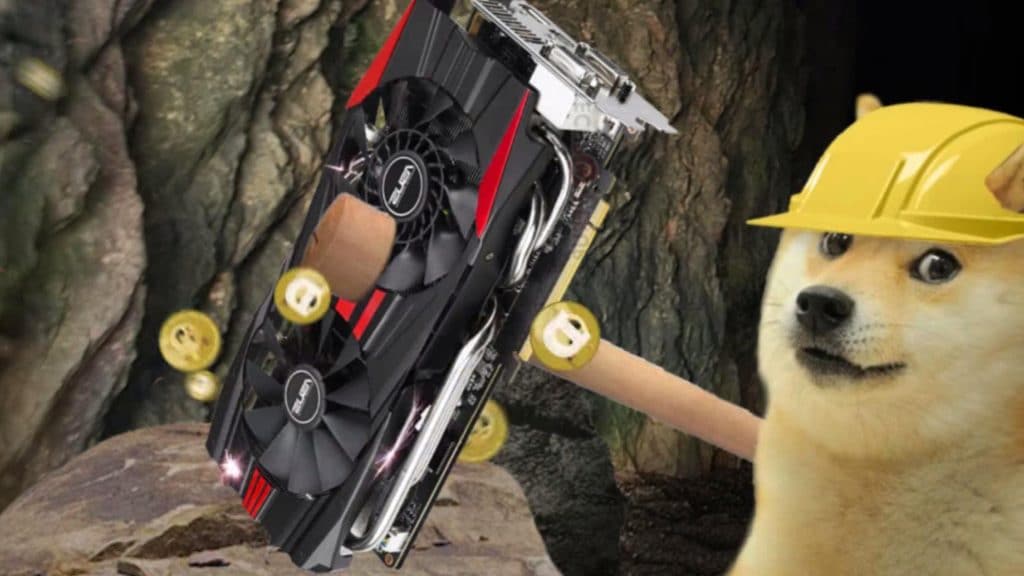
Ever since the first cryptocurrency, called «Bitcoin,» was created, mining has been and continues to be the life support for the proper functioning of cryptocurrencies. You’ve surely heard about Bitcoin mining at some point, and how some people have made quite a bit of money doing it — the so-called ‘Bitcoin millionaires.’
Mining is the process of validating and certifying the information held within transactions. Each set of transactions forms a block, and these blocks are created by miners and ordered chronologically, forming a chain of blocks (Blockchain).
Types of mining
There are many types of mining used to carry out this process, the most famous of which is called Proof of Work (PoW), which is also the most widely used today, being employed in Bitcoin and most other cryptocurrencies.
Proof of Work consists of exploiting the computing power of hardware to solve extremely complex mathematical problems, in order to determine which miner has the right to add a new block to the chain.
With each new block generated, the miner who solved the problem receives a reward in the mined cryptocurrency. This reward system serves to incentivize the use of hardware in cryptocurrency mining, which in turn achieves the sustainability and security of a Blockchain.
The reward — the amount of cryptocurrency received for each mined block — is programmed so that the supply is predictable and unalterable… So, will I always get the same amount of cryptocurrency over time?
Nope…
The amount of cryptocurrency you get from mining can vary mainly depending on the difficulty (although it also depends on how the reward supply was programmed to change over time). Difficulty refers to the increasing complexity of the mathematical problems to be solved, which are programmed to adjust according to the total computing power dedicated to the cryptocurrency. As more computing power gets added to mining that particular coin, the difficulty increases (you’ll get less), and conversely, if the total computing power dedicated to the coin decreases, the difficulty drops (you’ll get more with the same computing power).
Most cryptocurrencies are decentralized (although some centralized ones do exist, like Ripple (XRP), as we already discussed when explaining what blockchain is), meaning they’re not owned by anyone in particular. For these decentralized cryptocurrencies, there’s no way to prevent hardware from entering or leaving the mining pool, so the difficulty maintains the programmed balance in the number of blocks mined over time (each coin has its own block creation time), regardless of the total computing power. This, in turn, also governs the distribution of rewards among all miners over time, without requiring any trust.
Due to the constant increase in difficulty, small miners band together into «pools» to cooperate, combining their individual computing power into a collective one, enabling them to compete with other miners (since without a minimum amount of individual computing power, you won’t be able to solve a block) and get rewards faster. This doesn’t mean you’ll earn more coins overall — you’ll simply get the same amount, but spread out over shorter time intervals.
Different mining rigs for different purposes
Following the PoW method we mentioned earlier, mining can be done with the following types of hardware:
ASIC: Equipment manufactured and dedicated exclusively to mining cryptocurrencies based on their algorithm. This means each ASIC is programmed for one specific algorithm, so you can only mine the cryptocurrency that uses that same algorithm.
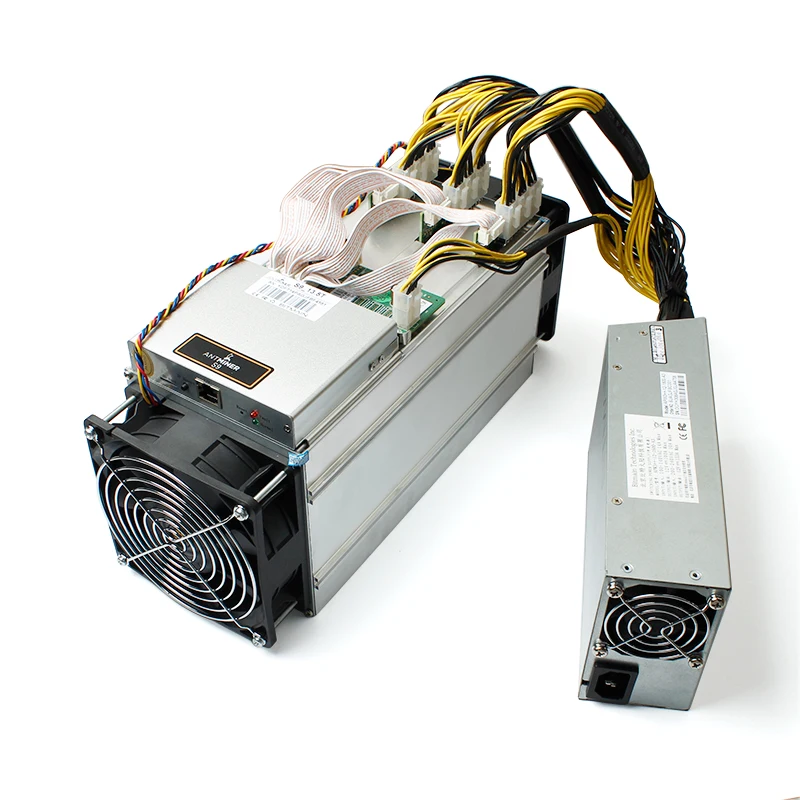
This option is much more practical than GPU mining, but you’re limited to the algorithm the ASIC you bought was built for.
GPUs: Mining with graphics cards allows you to mine any cryptocurrency with any algorithm. Setting up and configuring it is a more tedious process than the other options, but it comes with the advantage of being very versatile, so you can adapt the software and switch to whichever coin is most profitable at any given moment.
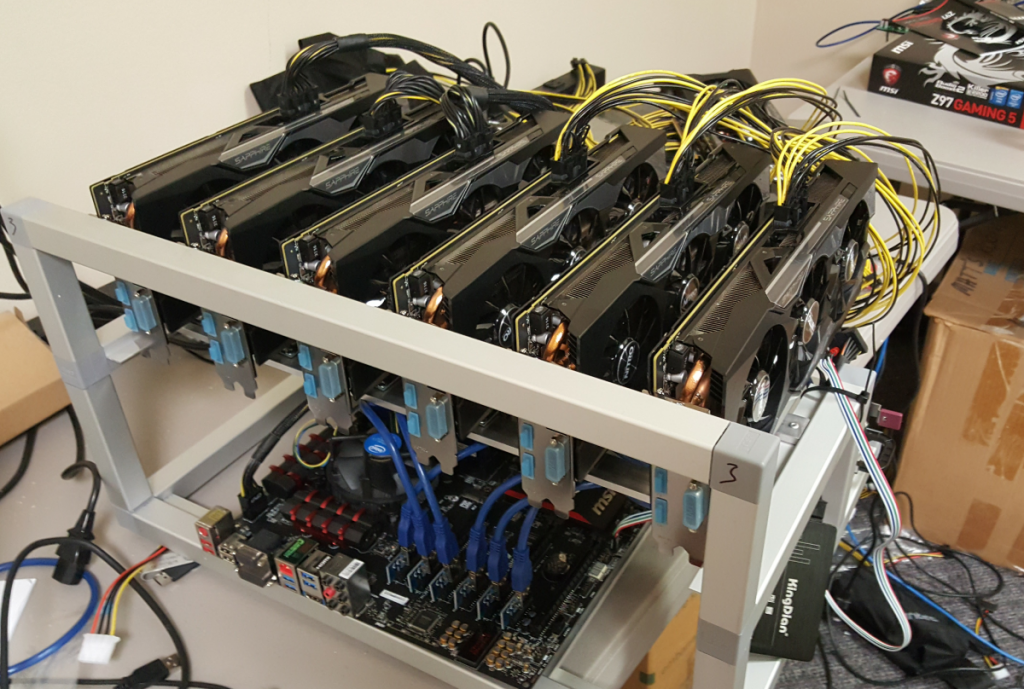
And then there are mining rigs using GPUs, like the one you see in the image above, which is basically a sort of ‘mini mining farm’ built from several GPUs… and it’s usually what people set up at home/office/garage/storage room (kind of like when people used to grow marijuana — honestly, it generates roughly the same amount of heat as those grow lamps :D).
If you’re thinking about building one of these but don’t know what hardware to pick, you can use the following setup as a reference:
What hardware should I buy?
Socket 1151 setup
CPU: The CPU is essential for the computer to run, but you don’t need great computing power or multitasking capability for the tasks it’ll be handling, so we can get a nice cheap one:
https://www.pccomponentes.com/intel-celeron-g3930-29ghz-box
MOTHERBOARD: The motherboard is one of the most important components in terms of compatibility, ensuring multiple graphics cards run correctly together. Also, keep in mind that all the other components sit on the motherboard and depend on it, so don’t skimp here — get a good board that won’t give you headaches down the line:
https://www.pccomponentes.com/asrock-h110-pro-btc
POWER SUPPLY: Depending on how much power your whole system draws, you’ll need more or less wattage. It’s a good idea to split the power load across several power supplies to protect their efficiency… and this also gives you a bit of high-availability insurance, since if one of them fails, your setup can keep running, just with less efficiency:
https://www.pccomponentes.com/evga-supernova-g2-750w-80-plus-gold-modular
Dual cable to connect two power supplies:
https://www.amazon.com/Second-Power-Supply-Mining-Cable/dp/B00JIV9BRK
RISER: These adapters can deliver 75W to a PCI x16 interface, allowing you to turn a conventional PCI interface running at x1 speeds into one running at x16 speeds:
RAM: How much RAM you need will depend on the number of graphics cards you want to connect, in order to keep the operating system running correctly and stably. An initial setup could start with 8GB, later expanding the virtual memory up to at least 16GB… although virtual memory isn’t as efficient as physical memory, so if you can afford it, it’s always better to add more RAM and install, say, 32GB. Also consider the RAM brand — some, for instance, guarantee proper operation even when overclocking (tweaking the RAM’s timings to make it faster). One of the classic brands that delivers great results is Corsair.
GRAPHICS CARD: And here’s where the real deal is. The graphics card will be the heart of your computing power when mining cryptocurrencies this way, so in terms of price/performance, it’s best to go with mid-to-high-end graphics cards. Nowadays, graphics card prices have jumped by up to 200% due to the high demand driven by crypto mining — much to the dismay of gamers who still just want to use them for playing video games.
AMD or NVIDIA?
The eternal question gamers have been asking for years. AMD has always been somewhat cheaper than NVIDIA, but they used to have trouble dissipating heat. That said, it depends on which cryptocurrency you’re mining — its algorithm will run more efficiently on one manufacturer or the other (architecture, memory speed, latency, etc.):
AMD gained a lot of ground by relying on brute force to make up for its lack of software-driven efficiency when it comes to squeezing performance out of the hardware, so AMD ended up coming out ahead in raw computing tasks. Because of this, AMD’s mid-range graphics cards got «wiped out» of the global market and eventually disappeared… shortly after, NVIDIA’s mid-range also vanished, so right now you can only get the basic range for people not interested in mining, and the high-end/beastly range for the most serious gamers and miners.
For example, if you want to mine cryptocurrencies like Ethereum (Ethash), AMD GPUs perform better with this algorithm, whereas if you want to mine, say, ZCash (Equihash), then NVIDIA is your best bet.
NVIDIA: https://www.pccomponentes.com/zotac-geforce-gtx-1060-6gb-gddr5-tarjeta-grafica (Zotac assembly with Hynix)
One thing worth noting is that Samsung memory modules run less efficiently than Hynix ones (based on tests mining Ethereum), so for the same power consumption you get better performance — up to a 4 or 5 mh/s difference when mining Ethash.
AMD: https://www.pccomponentes.com/msi-radeon-rx-580-armor-8g-oc-8gb-gddr5
If you end up going with AMD, you’ll notice that, when there’s stock available, the price will be higher than the NVIDIA option (this GPU should normally cost around €280-€320), but prices have shot up due to the high demand we mentioned earlier.
CPU: Nowadays, very few cryptocurrencies can still be mined with a CPU, as they’ve been outpaced by other technologies. The few that remain do so because their algorithm is specifically designed to be mined with this component. Outside of these cases, no cryptocurrency is profitable to mine with a CPU, given the constant growth of hardware dedicated to this purpose.
In Bitcoin’s early days, mining was done with CPUs, but as total computing power increased, CPUs fell short and GPUs became necessary… which eventually also fell short on power, which is why ASICs — which we mentioned earlier — are used today.
If you want to try mining with your own CPU or GPU without spending money on hardware, rigs, ASICs, and so on, purely for learning and academic purposes (which I fully recommend — you’ll learn a lot about how blockchain works, even if you’re not going to get rich), you can do so thanks to the huge number of simple, intuitive software setup guides scattered across the web (keep in mind that the workload will shorten your components’ lifespan). For example, the CROAT cryptocurrency has a single desktop app with an intuitive, simple interface for managing your wallets for that cryptocurrency and mining with your GPU or CPU in 5 easy steps:
CROAT MINING: https://croat.pool.cat/#getting_started
If after reading this post you decide to make whatever investment you see fit and start raking in cash like crazy, don’t forget to come back here and toss us a small BTC donation to the wallet address you’ll find in the sidebar on the right! 😀
Carlos Sahuquillo
'Haga lo que haga en la vida, siempre compito' - Jacques Villeneuve Reserva una sesión →
Entradas relacionadas

Business continuity: Cryptopia exchange is declared bankrupt after hacking
Idioma:CastellanoEnglish Ever since the first cryptocurrency, called «Bitcoin,» was created, mining has been and continues to be the life support for the…
Leer
They steal 7000 BTC from Binance
This time it's been Binance, one of the world's biggest Cyptomonedas. The attackers have taken 7000 Bitcoins using different techniques against the…
Leer
Bitcoin price change
Idioma:CastellanoEnglish Ever since the first cryptocurrency, called «Bitcoin,» was created, mining has been and continues to be the life support for the…
Leer
0 comentarios